Course Content
- Course Introduction and Instructor
- Focused Awareness and Yi Training
- Activating Inner Body Alchemy
- Tai Chi and Qigong Principles
- Patience and Prior Experience
- History of Wu Style Tai Chi
- Wu Style Advantages and Accessibility
- Traditional Transmission and Mantak Chia's Method
- About the Instructor
Course Description
This 2-day workshop is taught by martial artist Andrew Jan, and introduces Mantak Chia's Wu-style Tai Chi short form, a practical method for cultivating Chi (life energy) and Jin (internal force) throughout the body. Students train the focused awareness known as Yi while learning to open the meridians, joints, and energy system that make up Tai Chi's deeper internal work. The Wu style, with its more upright stance and forward-leaning spine, offers a gentler entry point than the more commonly taught Yang style, making it accessible to students of varying ages and levels of experience. The course is taught in English with occasional German translation.
Course Introduction and Instructor
This 2-day workshop is led by martial artist Andrew Jan, not by Grandmaster Mantak Chia, and combines English-language instruction with occasional German translation in the theory chapters. Students learn Mantak Chia's Wu-style Tai Chi short form, a method built around the smooth cultivation of Chi (life energy) and Jin (internal force). Participants are asked to review the Terms and Conditions before purchasing the course.
Focused Awareness and Yi Training
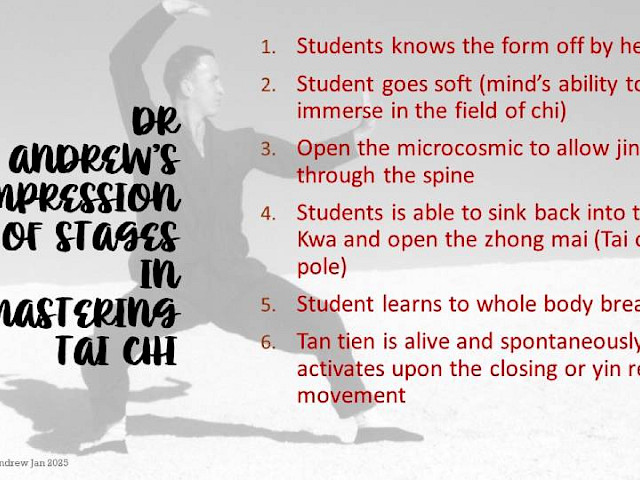
Tai Chi practice exercises the focused awareness known as Yi, flooding the body and sharpening the mind. How quickly Tai Chi develops in the body depends on the student's abilities, training hours, and the guidance of an accompanying teacher. The visible Tai Chi 1 form itself can typically be learned within 1 to 3 months.
Activating Inner Body Alchemy
Once the visible form is learned, the deeper work of activating inner body alchemy can begin, opening the meridians, joints, and the whole energy system. What the eye can see represents only about 20 percent of the practice; the greater part takes place internally, through a calm mind, physical flexibility, and the coordinated interplay of movement and breath that controls the flow of Chi. Balancing the body's energies in this way reflects what Classical Chinese Medicine holds as its highest aim.
Tai Chi and Qigong Principles
The roots of Tai Chi lie more in the martial arts, while Qigong derives from Chinese medicine, though both draw on the same underlying principles. Both are a form of dynamic meditation that consciously links breath with movement to control the flow of Chi through the body. In this sense, Tai Chi can be understood as an organized sequence of Qigong exercises.
Patience and Prior Experience
Developing these invisible, inner qualities calls for patience, correction, and repeated practice. Previous training in other disciplines, such as martial arts, yoga, or any form of Qigong, will support the learning process and can shorten the time needed to progress.
History of Wu Style Tai Chi
The Wu style is practiced less frequently than other Tai Chi styles and developed out of the Yang style. Its founder, Wu Chuan-Yu (1834 to 1902), modified the Yang style forms he learned from Yang Pan-Hou (1837 to 1892), the son of Yang Lu Chan.
Wu Style Advantages and Accessibility
Compared with the more commonly taught Yang style, Wu style is valued for its more natural postures and movements. Its spine may be held slightly bent forward and its stance somewhat higher, which allows for easier control and flow of Chi and Jin. This makes the short form accessible to students of all ages and abilities, letting them progress relatively quickly while still touching the essence of the principles and anchoring them in the body over time.
Traditional Transmission and Mantak Chia's Method
The techniques taught in this workshop have been passed down from generation to generation over hundreds of years as practical methods for improving physical, emotional, and mental health. Developed by Taoist Grandmaster Mantak Chia, the Wu Tai Chi style offers a simple method for cultivating both Chi (life energy) and Jin (internal force) as they flow throughout the body.
About the Instructor
Andrew Jan, who leads this workshop, is co-author with Mantak Chia, of the books: The Practice of Greater Kan and Li - Techniques for Creating the Immortal Self, 2014; Greatest Kan and Li - Gathering the Cosmic Light, 2014; Tai Chi Fa Jin - Advanced Techniques for Discharging Chi Energy, 2012; Tai Chi Wu Style - Advanced Techniques for Internalizing Chi Energy, 2013.
Important Notices
These teachings are provided for educational purposes only. They are not medical advice, diagnosis, or therapy. Please consult a qualified health professional regarding any health concerns before beginning or applying these practices.” Important education notice — through Andrew Jan Taoist Teachings Pty Ltd. These teachings are offered for educational and spiritual instruction and are not medical advice, diagnosis, or therapy. Traditional Taoist terms such as “healing,” “elixir,” “medicine,” or “pill” are used metaphorically and refer to inner cultivation rather than medical treatment. Descriptions of posture, breath, energy, or sensation reflect contemplative and cultural traditions, not health claims. These Taoist contemplative and breath-based practices may at times evoke emotional or psychological responses and are not suitable during pregnancy or during periods of significant emotional or psychological vulnerability. Participants with physical, medical, or psychological conditions, including significant trauma history or substance use, that may be affected by these practices, or those who feel unsure about their suitability, are recommended to seek appropriate professional guidance before participating. Teaching sessions may be recorded for educational purposes; no identifiable close-ups are intended, though voice or silhouette may appear incidentally. Content, livestreams, and recordings are not available to residents of the USA or Canada due to insurance restrictions. Participation is voluntary, and participants are responsible for their own wellbeing during and after the teachings and are encouraged to respect their limits and stop when needed.
---------
The content of this website is protected by copyright. You may download one copy of the information found on this website to a single computer for your personal, non-commercial, internal use.
Get this course
Course Videos
Mantak Chia's Tai Chi 3 Wu Style Form, Martial Artist Andrew Jan consists of 8 video files.
- 1. Day 1 Part 1 andrew-jan-tai-chi-3-wu-style 01:02:57
- 2. Day 1 Part 2 andrew-jan-tai-chi-3-wu-style 00:32:43
- 3. Day 1 Part 3 andrew-jan-tai-chi-3-wu-style 00:17:14
- 4. Day 1 Part 4 andrew-jan-tai-chi-3-wu-style 00:31:46
- 5. Day 2 Part 1 andrew-jan-tai-chi-3-wu-style 01:26:52
- 6. Day 2 Part 2 andrew-jan-tai-chi-3-wu-style 01:16:47
- 7. Day 2 Part 3 andrew-jan-tai-chi-3-wu-style 00:31:15
- 8. Day 2 Part 4 andrew-jan-tai-chi-3-wu-style 00:13:48
Free Bonus Material
Click to learn more about Master Chia.
-
 Mantak Chia Introduction (English)
01:57
-
 Mantak Chia Introduction (German)
02:01
-
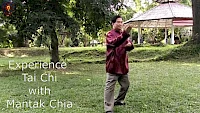 Experience Tai Chi with Mantak Chia
03:37
-
 Mantak Chia Morning Exercise
31:04
-
 Mantak Chia UHT System Overview: 9 Formulas
06:15
-
 Walter Kellenberger – How to become a UHT Qigong Level 1 Instructor
02:19
Mantak Chia Introduction (English)
Mantak Chia Introduction (German)
Experience Tai Chi with Mantak Chia
Mantak Chia Morning Exercise
Mantak Chia UHT System Overview: 9 Formulas
Walter Kellenberger – How to become a UHT Qigong Level 1 Instructor
Related Courses
Recommended Books

Bone Marrow Nei Kung

Knochenmark Nei Kung
Tao Yin - Exercises for Vitalisation, Health and Longevity

Tao Yin - Übungen für Vitalisierung, Gesundheit und Langlebigkeit
Nei Kung del Midollo Osseo
Tan Tien Qigong